On the roadIbiza
Parking at the calas, and why a small car wins on Ibiza
Jun–Sep
The road down to an Ibizan cala is usually one car wide, walled on both sides and ends in a dirt clearing with no room to turn. Once that clearing is full, the size of your hire car decides whether you park, reverse out, or spend forty minutes achieving neither. Where to drive, when to arrive, and when to leave the car behind.
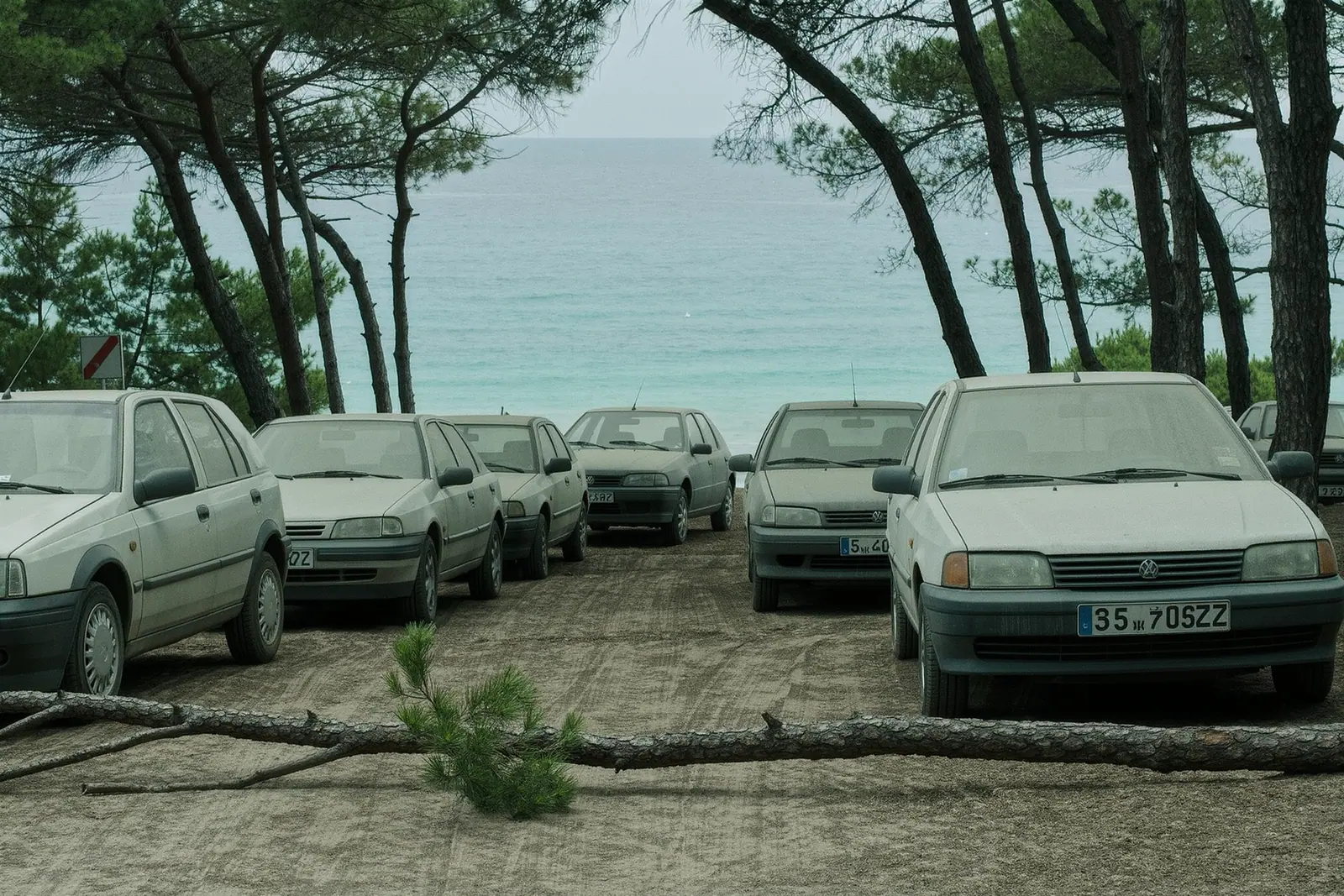
The typical Ibizan cove road does the same thing everywhere on the island. It leaves a surfaced road at a small sign, narrows to one car width between dry stone walls, drops through pine for a kilometre or two with three or four passing places, and ends in a dirt clearing under the trees. There is no turning circle. There is no overflow. When the clearing is full, the road becomes a queue with no way back out of it except reversing.
That geometry, not the price list, is the reason experienced visitors here rent the smallest car they can live with.
What the approach roads are actually like
Four features recur:
- One lane, two directions. Passing means one of you reverses to a bay. On a gradient. With a wall on one side.
- Dry stone walls at wheel-arch height. They do not move and they do not scratch politely.
- A dirt final stretch at a good number of calas, which is also where your hire contract’s unsurfaced-roads clause becomes relevant.
- Overhanging pine. Fine in a hatchback, a paint problem on anything tall, and a real problem with a roof box.
The damage that results is exactly the damage that basic cover excludes: alloys, tyre sidewalls, the underside and the roof. That is not a coincidence.
Cala by cala, roughly
| Cala | Access | Parking | Full by |
|---|---|---|---|
| Cala Comte and Cala Bassa, west | Surfaced, wide-ish | Managed car parks, charged in season | Late morning |
| Cala Salada, north of Sant Antoni | Narrow, and seasonally restricted to a shuttle | Very limited when open | Immediately |
| Benirràs, north | Steep, narrow, walled | Terraced dirt above the beach | Mid-morning, and chaos on a Sunday evening |
| Cala d’Hort, south-west | Surfaced to the top, then down | Charged in season, decent size | Midday |
| Ses Salines and Es Cavallet, south | Through the natural park | Managed, with strict verge rules | Late morning |
| Cala Mastella and Pou des Lleó, east | Narrow lanes, some dirt | A handful of spaces | Very early |
| Cala Xarraca and Cala Xuclar, north | Short dirt spurs | Informal, small | Mid-morning |
| Cala Llenya and Cala Nova, east | Easy, surfaced | Large and usually fine | Rarely a problem |
The last line is the useful one. The east coast has several calas with real car parks and no access drama, and they are pleasant beaches. Everyone drives past them to sit in a queue on the west coast.
Two categories in that table need extra thought. The coves inside the natural park in the south are managed, with painted bays and a clear rule against parking on the sand or the verge, and the rule is enforced because the ground either side is dune. The north-coast spurs are the opposite problem: informal, unsurfaced and often only wide enough for a single line of cars, so the vehicle that arrives fifth has nowhere to go and nowhere to turn. Neither of those is somewhere to find out that your contract excludes unsurfaced roads.
Timing beats everything
The pattern at the popular coves is consistent through July and August:
- Before 10:00 — spaces, shade under the pines, and the water at its clearest.
- 10:00–12:00 — filling. The last quarter of the car park goes in about twenty minutes.
- 12:00–16:00 — full. Cars circulating, some parking illegally, occasional recovery trucks.
- 16:00–18:00 — the turnover hour. Wait five minutes at the entrance rather than driving in.
- After 18:00 — empty again, and on the west coast this is the best part of the day anyway.
An early start also solves the heat problem and the boat traffic problem, because the day boats arrive from about eleven.
The alternatives worth pricing
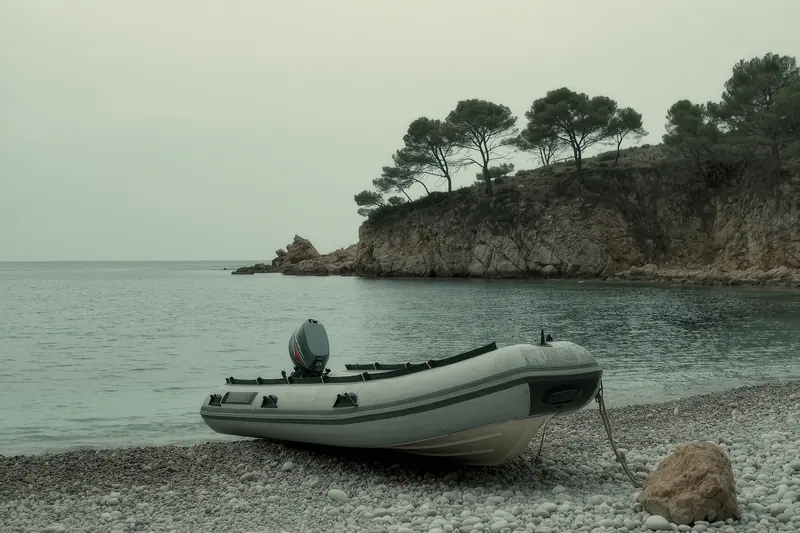
Boat. For the west coast in particular, a small hired boat reaches Salada, Bassa and Conta in twenty minutes and parks in the water.
Seasonal bus and shuttle. Where a shuttle replaces cars on an access road, it is faster than driving because it does not have to find a space. Routes and timetables change annually.
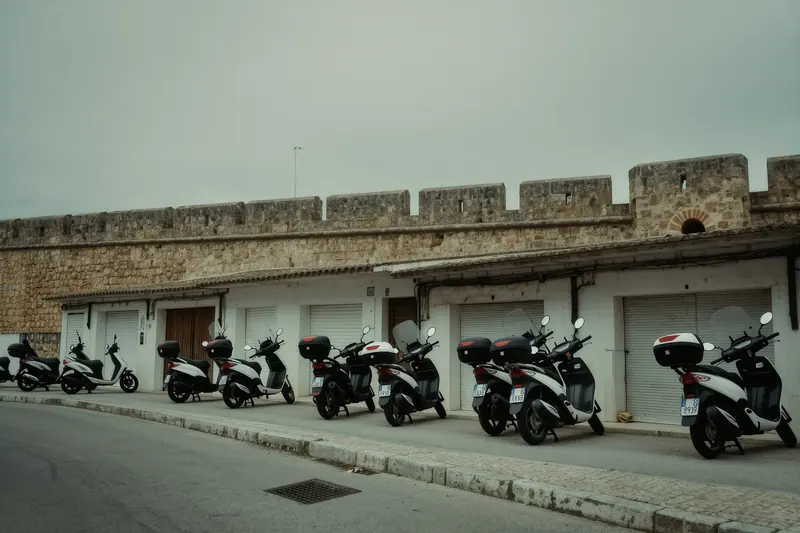
Scooter. Parks anywhere, gets you down the narrow lane past the queue, and carries nothing. Good for two people with a towel each, useless for a family day — the town-riding case is made in scooter hire for the Ibiza town maze.
Walking the last part. Park where the road is still wide and take ten minutes on foot. This is what residents do, and it is why you see cars neatly lined up half a kilometre before the beach.
What to book
A small manual hatchback, booked early because that category disappears first. No roof box if you can avoid it. Written permission for unsurfaced roads if any of your plans involve the north, since that is the same clause that governs the dirt tracks up there.
And accept the trade at the top of the day: the beach you can park at is not the one in the photographs, and the one in the photographs is empty at eight in the morning and at seven in the evening. Both of those are better times to be in the water anyway.
What to check before you book
- Book the smallest car the group and the luggage genuinely fit into. Width and turning circle matter more here than power or comfort.
- Check whether the access road to the cala you have planned is open to private cars in the peak months, because some are seasonally restricted with a shuttle instead.
- Confirm in writing whether your contract permits unsurfaced roads, since the last stretch to several calas is dirt.
- Never park on the verge inside a protected area or on soft ground under pines. Both are enforced and one is a fire risk.
- Carry coins and a card for the paid car parks, and take a photo of where you left the car — the pine clearings look identical.
- Check the spare wheel or repair kit exists before the first beach day, not after the stone chip.
Questions people actually ask
- What time should I arrive at a popular cala in August?
Before ten, or after four. The car parks above the well-known coves on the west coast fill through the middle of the morning and stay full until mid-afternoon, and once they are full there is no queue system, just cars circulating. Arriving at half past eleven is the single most common mistake, and it costs about forty minutes.
- Are the cala car parks free?
It varies and it changes. Several of the busier ones on the west and south coasts are managed and charged in season, others are informal dirt clearings, and a few sit inside a protected area with its own arrangement. Assume you will pay something at the popular ones and carry both coins and a card.
- Can I park on the road if the car park is full?
Usually not, and on the approach roads to the busier calas it is actively enforced in summer. The lanes are single track with dry stone walls, so a parked car blocks the road for everyone including emergency vehicles. Parking on soft ground under pines is a separate problem: it is prohibited inside protected areas and it is a genuine fire risk in high summer.
- Does a bigger car really make that much difference?
Yes, in three specific places: the width of the walled lane on the way down, the turning circle in a clearing designed around small hatchbacks, and the bay size in a managed car park. A large estate or a seven-seater will get you there and then leave you reversing four hundred metres uphill past oncoming traffic. It is not a comfort question, it is a geometry one.
- Is there a bus to the beaches?
To some of them, on seasonal routes that run from the main towns, and in a few cases a shuttle replaces private cars entirely on the access road during the peak months. Timetables and routes change every season, so check the current service rather than an old blog. Where a shuttle exists it is usually faster than driving, because it does not have to park.