On the waterIbiza
Renting a tender for the calas the roads do not reach
May–Oct
A handful of Ibizan coves are reached by rope, by goat path, or not at all. A small rigid inflatable turns each of them into a twenty-minute run. Which ones are worth it, which of them you should only look at from the water, and the landing technique that keeps the propeller and the deposit intact.
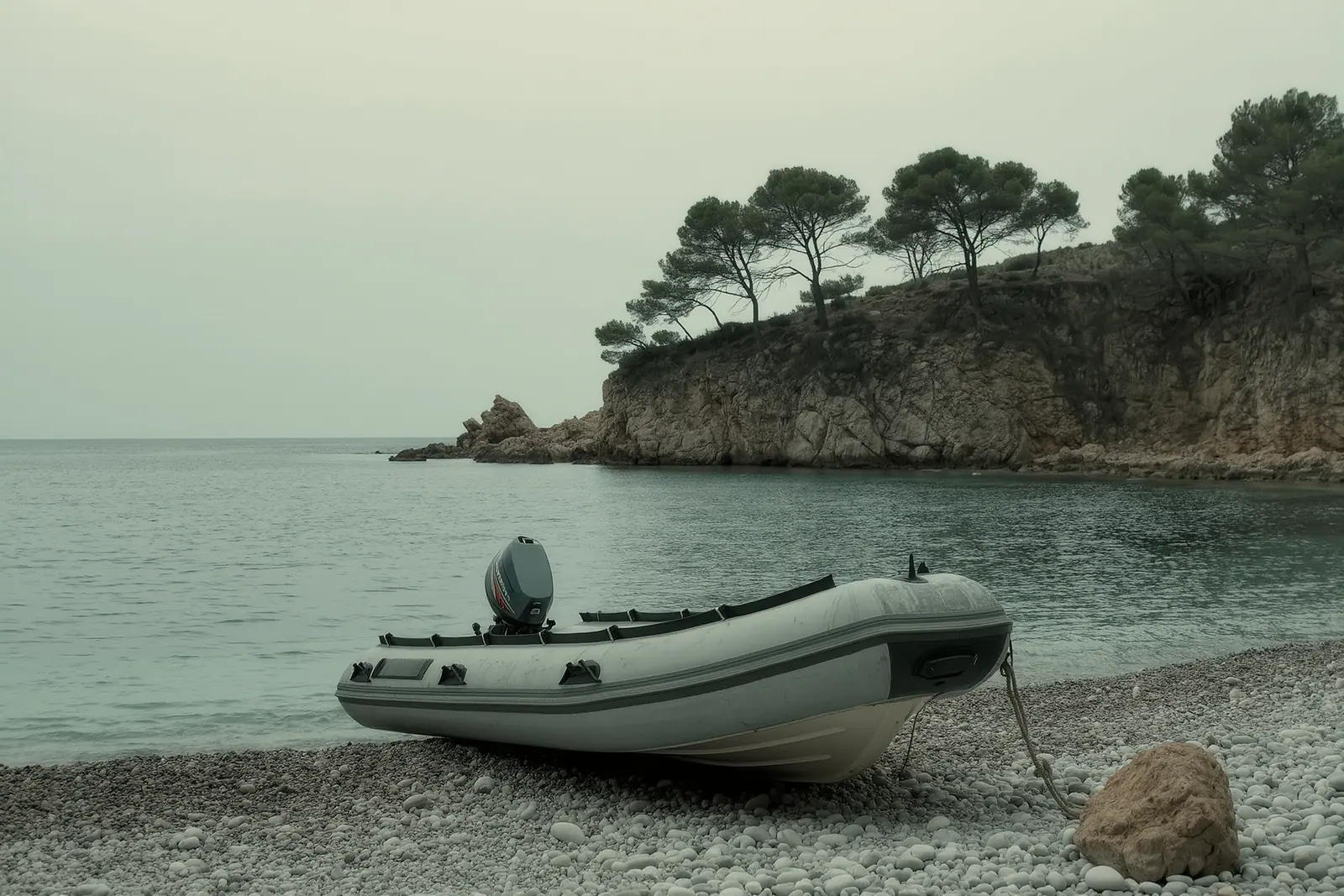
There is a cove on the north-west coast of this island that you reach by walking down a dry gully with fixed ropes in it, carrying whatever you want to have with you at the bottom. There is another on the south-west corner where a track gives up on the hillside and leaves you a footpath. There are half a dozen more where the road exists but is a rutted dirt descent that no hire car contract permits.
All of them are fifteen to thirty minutes away in a small boat with an outboard on the back. That is the entire argument for renting a tender here.
What “no road” means on Ibiza
Three different situations get described the same way, and they need different responses:
- No access at all except by sea or by rope. Ses Balandres, below the cliffs near Santa Agnès, is the clearest example. The descent is a scramble with fixed lines and it is not a family outing.
- A footpath, twenty to forty minutes each way. Cala Llentrisca out beyond Es Cubells; the old quarry at Sa Pedrera below the cliffs near Cala d’Hort, which everyone calls Atlantis. Both are perfectly walkable and both are unpleasant in August heat with a cool box.
- A dirt track that a hire car may not use. Cala d’en Serra in the north, and the approaches to several of the smaller north-coast coves. The track exists, your rental agreement excludes unsurfaced roads, and the excess is yours. That is the situation a buggy or 4x4 is sold to solve, and the boat is often the better answer.
The runs worth making
- Port de Sant Miquel to Es Portitxol. Fifteen minutes west along a cliff coast into a pebble cove lined with old timber boat huts. It is the most atmospheric short run on the island and the huts are private property, so look, do not lean.
- Portinatx to Cala d’en Serra. Ten minutes. A small sand-and-pebble bay with a half-finished concrete shell above it, empty most mornings, and much pleasanter arrived at by water than at the bottom of the track.
- Sant Antoni to Ses Balandres and the Cap Negret shelves. Twenty-five minutes north on a flat morning. Do not attempt to land; anchor off in the clear water and swim.
- Es Cubells or Cala d’Hort to Cala Llentrisca and Sa Pedrera. Fifteen to twenty minutes along the base of the south-west cliffs, with Es Vedrà standing offshore for the whole run.
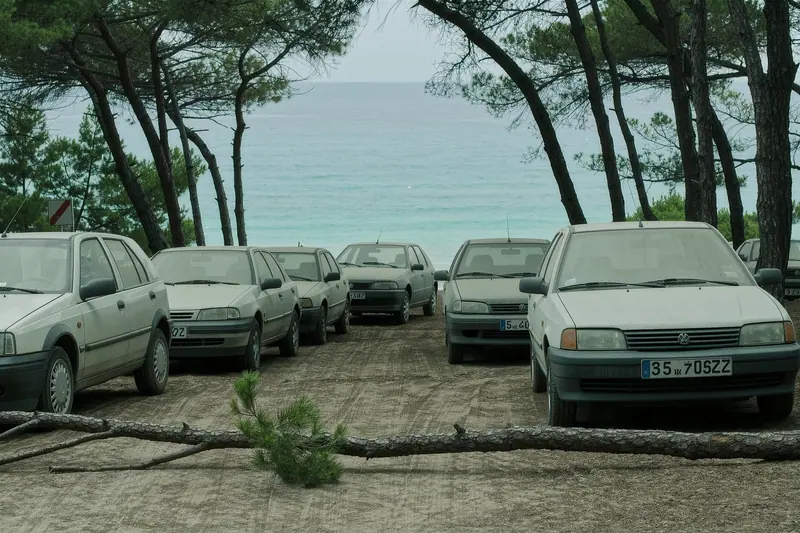
- Santa Eulària to the small calas up towards Sant Carles. Cala Mastella, Cala Boix and the rocky notches between them. Roads exist to most, and the parking does not, which amounts to the same thing in August.
What to hire, and from where
A rigid inflatable in the small licence-free band is the right tool. It is light, it tolerates being nudged against rock better than a fibreglass hull, and it draws almost nothing, which matters when the cove has a boulder shelf across the mouth. What it does not have is shade, a toilet or any capacity for chop.
Launch points that make sense, by target: Sant Antoni for the north-west, Portinatx and Port de Sant Miquel for the north, Santa Eulària for the east, and the south-west coves from a base in Ibiza town if you are prepared for the transit. The licence question, the area clause and the daylight rule all apply exactly as they do to any other small hull, which is set out in licence-free boat hire.
Landing, which is the part that costs money
Most of these coves are pebble, boulder or rock ledge. Sand is the exception on this coast, not the rule. The sequence:
- Stop outside and look. If the swell is lifting and dropping a metre on the stones, do not land. Anchor off and swim in with a dry bag.
- Come in bow first, dead slow, someone forward watching the bottom.
- Tilt the outboard before the depth gets interesting, not while it is grinding.
- Step out in knee-deep water and walk the boat. Never drive it up.
- Carry a stern anchor out into the water behind you, or you will come back to a boat sitting on rock.
Where the bottom outside is dark, remember what that colour means and why it matters on a rented hull — the rules on anchoring over the seagrass apply to a five-metre tender exactly as they do to a fifty-foot catamaran.
What to take, given there is nothing there
Water, more than you think. Shade of some kind, even an umbrella wedged under a seat. Shoes you can walk on rock in. A dry bag with phone, keys and the contract. Cash, because a couple of these coves have a seasonal shack and none of them has a card machine you can rely on. And the base’s phone number on paper, since several of the north-coast coves have no usable signal at the bottom of the cliffs.
The one to skip
Sa Pedrera, the old quarry cut into the cliff below Cala d’Hort, is spectacular and is not a boat destination. The landing is onto rock ledges with swell running along them, the anchorage outside is deep and awkward, and the site itself is a walk uphill from the water over sharp stone. It is genuinely worth seeing, and the honest way to see it is on foot from above, early, with proper shoes. Renting a boat to get to it is a way of arriving somewhere you then cannot get out of.
What to check before you book
- Ask explicitly whether beaching the boat is permitted. Many contracts forbid it and charge for the damage a pebble beach does to a hull.
- Confirm the fuel range in hours at cruising speed, not in litres, and plan the trip at half of it.
- Check the anchor and the length of the chain. A small folding anchor on rope will not hold you off a lee shore for lunch.
- Take the base phone number written on paper. There is no mobile signal in several of the coves on the north coast.
- Ask what shade the boat has. On a RIB the answer is usually none, and four hours of that is a real problem.
- Verify the distance-from-shore limit on the contract before planning a run along the north coast, where the shelter is thin.
Questions people actually ask
- Which Ibizan coves genuinely have no road?
Ses Balandres below Santa Agnès is reached by a rope-assisted scramble down a gully and by nothing else. Cala Llentrisca near Es Cubells has a footpath and a rough track that stops well short. Es Portitxol on the north-west coast is a walk in from a track. Cala d'en Serra in the north has a dirt track that deteriorates as it drops. Each of them is fifteen to thirty minutes by small boat from a place you can launch.
- Do I need a licence for a small RIB?
Frequently not, if the hull length and engine power fall below the national threshold, but that threshold is set nationally and revised from time to time. Get the exact length and horsepower from the operator and confirm the current limit with them and with the maritime authority. A briefing is not a certificate and does not extend where you are permitted to go.
- Can I land on the beach?
Only if the contract allows it, and plenty do not. Where it is allowed, the technique matters: approach slowly bow first, tilt the engine before the water shallows, and step out to walk the boat in rather than driving it up the stones. Ibizan coves are mostly pebble or rock rather than sand, and a hull dragged over pebbles picks up damage that comes straight out of the deposit.
- Is the north coast safe in a small boat?
On a settled morning, yes, with sense. It is a steep coast with few places to shelter and long stretches without any, the swell wraps round the headlands even in light wind, and mobile signal is patchy. Go early, go with the forecast in front of you, and turn back rather than press on. The prevailing westerly builds through the afternoon and you will be heading into it.
- How much does a small tender cost to hire?
A small RIB in the licence-free band typically runs from around a hundred euros for a half day in the shoulder season to two or three times that in the first three weeks of August, with fuel and a deposit on top. Half days are the sensible unit: the coves are close, and nobody wants six hours in an open boat with no shade.