Two wheelsIbiza
E-bike rental and the hills of northern Ibiza
Mar–Nov
The north of Ibiza is where the island stops being flat. Short, steep climbs between Sant Joan, Sant Miquel, Portinatx and the coves below them turn a pleasant ride into an ordeal on a hire bike. What a motor changes, how to read a range claim honestly, where the surfaces get loose, and what to arrange before you set off.

The road out of Port de Sant Miquel goes up. Not gradually — it leaves the water and climbs hard for a couple of kilometres in full sun, and by the time you reach the village you have done the same work as a long flat hour somewhere else. Every cove on this coast has a version of that climb behind it, because every cove is at the bottom of something.
This is the case for a motor, made by the terrain rather than by a salesperson.
What the north actually does to a bike ride
Ibiza’s northern third — Sant Joan de Labritja, the Es Amunts uplands, the villages of Sant Miquel, Sant Mateu and Sant Llorenç — is not mountainous in an alpine sense. Nothing here is a long pass. What it is instead is relentlessly undulating, with gradients that are short and steep rather than long and steady.
That shape punishes an ordinary hire bike specifically. A cruiser or a basic hybrid with a narrow gear range gives you nothing on a fifteen per cent ramp out of a cala, and you walk. A motor flattens exactly this profile, because assistance is at its most useful in short bursts.
| Route from Sant Joan | Rough distance | Character | Without a motor |
|---|---|---|---|
| Down to Benirràs and back | Short, out and back | Steep descent, steep climb out | Hard, and hot |
| Sant Miquel and the port | Half day | Two real climbs, quiet lanes | Fit riders only |
| Portinatx loop | Half to full day | Rolling, exposed, some traffic | A long day |
| Cala Sant Vicent | Half day | One long descent, one long climb | Hard |
| Sant Mateu and the wine country | Half day | Gentler, inland, shaded in parts | Manageable |
The Sant Mateu direction is the outlier and it is the one to take if the group is mixed. It runs inland through vine and almond country rather than dropping to the sea, so the profile is kinder and the return is not a wall.
Reading a range claim honestly
The number on the listing is not a lie, it is a laboratory figure. It assumes low assistance, flat ground, a moderate rider weight and a full charge on a battery that is not two seasons old.
Work with watt hours instead. Ask for the battery capacity, then plan on the basis that hilly riding in a middle assistance mode consumes noticeably more per kilometre than the flat-ground assumption behind the marketing figure. Halving the advertised range and treating the result as the outer limit is a reliable rule in the north.
Three things that shorten it further here: heat, which reduces performance and makes riders reach for more assistance; headwind on the exposed sections towards Portinatx; and the temptation to sit in the highest mode on every climb because it is enjoyable.
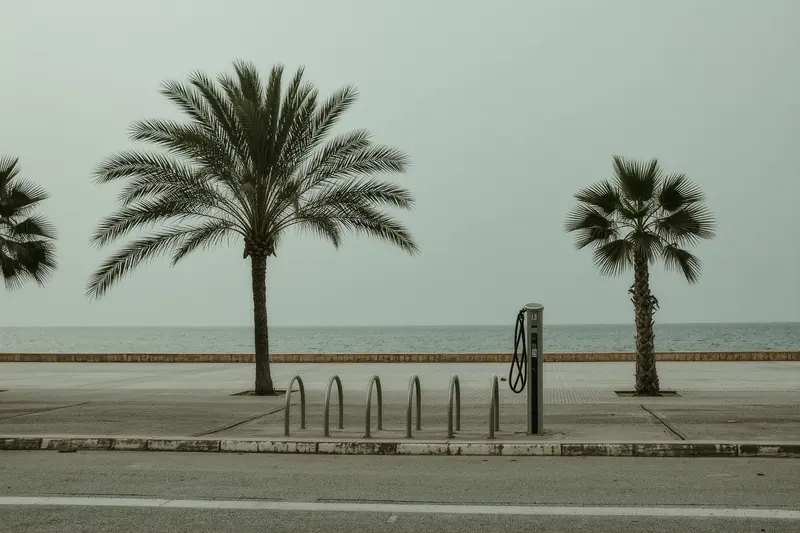
There is no charging infrastructure to fall back on. Plan a loop you can finish, carry the shop’s number, and ask before you set out what recovery costs, because a dead battery is a very heavy bicycle and the north has long stretches with no bus and patchy mobile signal.
Surfaces, and the camí problem
Ask the hire shop what tyres are on the bike. Almost every interesting destination in the north involves at least a short section of unsurfaced camí — the red dirt tracks that link the villages to the coast and to the fincas — and they range from smooth compacted earth to loose gravel with ruts.
A hybrid e-bike on narrow slick tyres is unhappy on those. Something with a wider tyre and a bit of tread is the right hire here even if you intend to stay on tarmac, because at some point you will not.
The other surface question is brakes. These descents are steep, long and often end in a bend above a drop. Hydraulic disc brakes on a heavy e-bike are not a luxury. Test both on the flat outside the shop.
Getting the bike to a northern base
The hire shops are in the resorts and in Ibiza town. The riding is in the north. That gap is the main practical friction, and it has three solutions.
Delivery. Most e-bike operators will deliver to a villa, usually for a fee that scales with distance, and it is worth it. Confirm they can reach the property — a van on a narrow camí is the same problem as every other delivery here, discussed further in finca in the north or villa on the west coast.
Carrying them. A hire car with a rack, if the rental company permits a rack at all. Many do not, and fitting one to a car you do not own is a conversation to have before you book.
Renting locally for the day. Thinner on the ground in the north, better in spring and autumn than in the closed winter months.
Whether the motor is worth the money
An e-bike costs several times a basic hybrid per day, and in Santa Eulària on the flat that is money wasted — see the coastal path for what a plain bike does perfectly well. In the north it is the difference between a ride and a retreat.
The honest test is the group. One strong rider will enjoy these hills unassisted and should hire a proper road bike instead, as set out in road cycling on Ibiza. Four people of mixed fitness, in July, planning to come back up from a cove at four in the afternoon: hire the motors, take the wide tyres, and go in the morning anyway.
What to check before you book
- Ask for the battery capacity in watt hours, not the range in kilometres. Range claims assume flat ground and a light rider.
- Confirm the bike arrives fully charged and ask for the charger, or agree where you can charge mid-route.
- Check the brakes are hydraulic discs and are recently bled. The descents here are steep and long.
- Ask whether the tyres suit unsurfaced camins, because most northern routes include some.
- Get the recovery arrangement in writing: what happens if the battery dies twenty kilometres out.
- Confirm whether delivery to a rural villa is possible and what it costs, since the north has few shops.
Questions people actually ask
- How far will an e-bike really go in northern Ibiza?
Assume roughly half to two thirds of the advertised figure. Range claims are produced on flat ground in the lowest assistance mode with a light rider, and the north is a series of short steep climbs where the motor works hard. A mid-sized battery that claims a hundred kilometres will realistically cover fifty to sixty here with normal use, less with a heavier rider or high assistance.
- Which northern routes are worth doing?
The loop from Sant Joan de Labritja out to Portinatx and back over the inland roads, the run down to Port de Sant Miquel and along towards Benirràs, and the road across to Cala Sant Vicent are the three that repay the effort. All involve descents to sea level and climbs straight back out, which is exactly the shape of ride an e-bike transforms.
- Can I charge an e-bike while I am out?
Not reliably. There is no charging network for e-bikes on the island and the north has few businesses open outside summer, so plan a route you can complete on one charge. Some cafés will let you plug in if you ask and buy something, but a full charge takes hours, so treat it as a rescue rather than a plan.
- Are the roads in the north busy?
Much less so than the centre and the south, which is the appeal. The C-733 through Sant Joan carries steady traffic in August, but the lanes off it towards Sant Miquel, Benirràs and Sant Mateu are quiet even in high season. What they lack is shoulder width and lighting, so ride in daylight and take the descents on the assumption that a car is coming.
- Is an e-bike better than hiring a car for exploring the north?
For a day, often yes — parking at the northern coves is limited and the lanes are more pleasant at bike speed. For a week based up there it is not a substitute, because the supermarket run and the airport transfer still need a vehicle. The best combination is a car for logistics and an e-bike for the days you actually want to be outside.